FULL ARCH OPTIONS
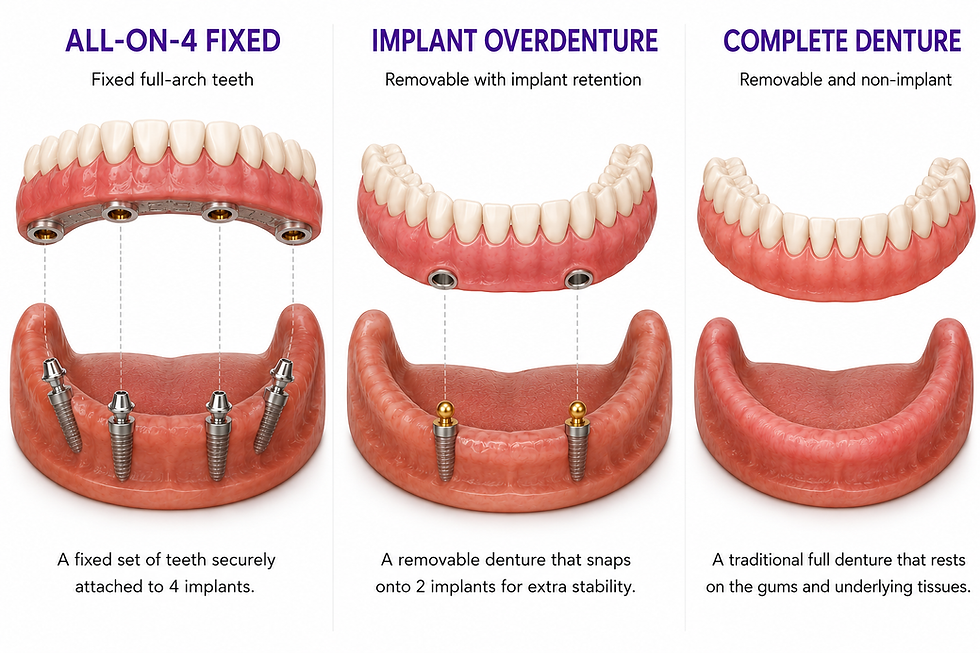
ALL-ON-4 FIXED
IMPLANT OVERDENTURE
COMPLETE DENTURE
TYPE
Fixed
Removable
Removable
IMPLANTS
Usually 4 or more
Usually 2 or more
None
PATIENT REMOVES IT
No
Yes
Yes
HOW IT STAYS IN
Secured to implants
Attaches/snaps onto implants
Relies on fit, gums and underlying anatomy; denture adhesive may be needed for additional retention
STABILITY
High
Improved by implant attachments
Varies; denture adhesive may help improve retention and stability
IMPLANT SURGERY
Yes
Yes
No
CLEANING
Clean around and underneath
Remove and clean daily
Remove and clean daily
KEY BENEFIT
Fixed full-arch teeth
Implant retention while remaining removable
No implant surgery
KEY CONSIDERATION
Surgery, healing & maintenance
Attachments wear and require maintenance
May move during function; fit can change as the ridge and tissues change
FULL ARCH — FIXED PROSTHESIS (ALL-ON-4)
A full-arch fixed implant prosthesis is designed to replace an entire arch of missing or failing teeth with a prosthesis that is supported by dental implants.
The term “All-on-4” commonly refers to a full arch of teeth supported by four strategically positioned dental implants. Depending on the amount and quality of available bone, bite, anatomy, and treatment needs, more than four implants may sometimes be recommended.
Unlike a conventional denture or implant overdenture, the final prosthesis is fixed to the implants and is not removed by the patient.
1. CONSULTATION & 3D EVALUATION
Treatment begins with a comprehensive evaluation of the teeth, gums, jawbone, bite, smile, and overall condition of the mouth.
A CBCT/3D scan is used to evaluate:
• Available bone height, width, and quality
• Important anatomical structures
• Possible implant positions and sizes
• Areas of bone loss
• Whether bone grafting or other procedures may be needed
The condition of any remaining teeth is also evaluated to determine whether they can reasonably be maintained or whether removal and full-arch treatment should be considered.
2. TOOTH REMOVAL & PREPARING THE ARCH
If failing teeth remain, they are removed as part of the surgical treatment.
The jawbone may need to be reshaped or leveled to create appropriate space and a suitable foundation for the implants and prosthesis.
Not every patient requires the same amount of bone modification.
Bone grafting may also be performed when appropriate.
3. PLACING THE IMPLANTS
Implant sites are carefully prepared in the jawbone using a planned sequence of surgical drills.
For an All-on-4 treatment, four implants are strategically positioned across the arch to support the prosthesis.
In some cases, five or six implants may be recommended when the anatomy, available bone, prosthetic design, or treatment plan indicates that additional implant support would be beneficial.
After the implants are placed, specialized components called multi-unit abutments may be connected to the implants. These components provide the connection between the implants and the fixed full-arch prosthesis.
4. CAN I GET FIXED TEETH THE SAME DAY?
Sometimes.
When the implants achieve adequate initial stability and other clinical conditions are favorable, a temporary fixed prosthesis may be connected to the implants on the day of surgery or shortly afterward.
This is commonly called immediate loading.
The temporary prosthesis allows the patient to have fixed teeth while the implants are healing.
IMPORTANT:
Same-day fixed teeth are not appropriate for every patient.
The implants still need time to integrate with the surrounding bone. During this healing period, excessive biting forces can interfere with healing.
Patients receiving an immediate temporary prosthesis must follow dietary and post-operative instructions carefully.
If adequate implant stability cannot be achieved, a removable temporary prosthesis or another healing approach may be recommended instead.
5. HEALING & BONE INTEGRATION
After implant placement, the bone gradually heals around the implants through a process called osseointegration.
TYPICAL HEALING TIME:
APPROXIMATELY 4–6 MONTHS
Healing time varies depending on implant stability, bone quality, grafting, medical factors, and the individual patient's healing response.
Some cases may require additional healing time before the final prosthesis is made.
6. FINAL FIXED PROSTHESIS
After the implants have healed sufficiently, the final prosthetic phase begins.
Digital scans, impressions, bite records, photographs, and other records may be used to design the final teeth.
The final prosthesis is evaluated for:
• Fit
• Bite
• Tooth position
• Speech
• Appearance
• Ability to clean underneath the prosthesis
The completed full-arch prosthesis is then securely attached to the implant system.
The patient does not remove the prosthesis at home. When professional removal is necessary, it is performed by the dental team.
7. CLEANING & LONG-TERM MAINTENANCE
Fixed does not mean maintenance-free.
Food, plaque, and bacteria can accumulate underneath and around a full-arch prosthesis.
Patients must learn how to clean underneath the prosthesis and around the implants using appropriate home-care techniques and cleaning aids.
Professional maintenance visits are important so the implants, gums, bone, bite, prosthesis, and prosthetic components can be evaluated.
Although dental implants cannot develop cavities, inflammation and bone loss can occur around implants if plaque and bacteria are not adequately controlled.
The prosthesis and its components can also experience wear, loosening, chipping, fracture, or other mechanical problems over time and may require maintenance or repair.
IMPORTANT: ADVANTAGES & LIMITATIONS
A full-arch fixed implant prosthesis can provide significantly greater stability than a conventional removable denture and does not require the patient to remove the teeth for routine daily use.
However, treatment requires implant surgery, a healing period, careful home maintenance, professional follow-up, and long-term prosthetic maintenance.
Not every patient is a candidate for immediate fixed teeth or the same implant configuration.
EVERY CASE IS DIFFERENT
The number and position of implants, need for extractions or bone grafting, ability to provide immediate fixed teeth, healing time, and final prosthesis design depend on the individual patient's anatomy, bone, bite, health, and treatment needs.
We explain the treatment, alternatives, advantages, limitations, and expected maintenance so you can make an informed decision.
EDUCATE. GUIDE. THE PATIENT DECIDES.
IMPLANT OVERDENTURE
An implant overdenture is a removable full-arch prosthesis that uses dental implants to improve the retention and stability of a denture.
Unlike an All-on-4 fixed prosthesis, an implant overdenture is designed to be removed by the patient for cleaning.
Unlike a conventional complete denture, the prosthesis connects to implants through attachment components that help hold the denture in position.
1. CONSULTATION & 3D EVALUATION
Treatment begins with an evaluation of the teeth, gums, jawbone, bite, existing dentures, and overall condition of the mouth.
A CBCT/3D scan is used to evaluate:
• Available bone height, width, and quality
• Important anatomical structures
• Possible implant positions and sizes
• Areas of bone loss
• Whether bone grafting or other procedures may be needed
If teeth remain, their condition is evaluated to determine whether they can be maintained or need to be removed.
2. TOOTH REMOVAL & PREPARING THE ARCH
If failing teeth remain, they may need to be removed before or during implant treatment.
The gums and bone are evaluated to create an appropriate foundation for the future overdenture.
Bone grafting or modification of the ridge may sometimes be recommended depending on the individual condition.
3. PLACING THE IMPLANTS
Implant sites are carefully prepared in the jawbone using a planned sequence of surgical drills.
For a lower implant overdenture, two implants are commonly used to provide additional retention.
Depending on the anatomy, available bone, prosthetic design, and treatment goals, additional implants may sometimes be recommended.
After implant placement, the implants are allowed to heal and integrate with the surrounding bone.
4. HEALING & BONE INTEGRATION
The implants must become stable within the jawbone through a process called osseointegration.
TYPICAL HEALING TIME:
APPROXIMATELY 3–6 MONTHS
Healing time varies depending on implant stability, bone quality, grafting, medical factors, implant location, and the patient's individual healing response.
During the healing period, an existing denture may sometimes be modified or a temporary denture may be provided.
5. CONNECTING THE OVERDENTURE
Once the implants have healed sufficiently, attachment components are connected to the implants.
These attachments allow the denture to engage or “snap” onto the implants.
Corresponding attachment housings are incorporated into the underside of the overdenture.
When the patient inserts the denture, the attachments engage and provide additional retention and stability.
The patient can still remove the overdenture when necessary.
6. HOW IS THIS DIFFERENT FROM ALL-ON-4?
Both treatments use dental implants, but they function differently.
ALL-ON-4 FIXED:
The prosthesis is secured to the implants and is not routinely removed by the patient.
IMPLANT OVERDENTURE:
The prosthesis attaches to the implants for retention but remains removable by the patient.
An implant overdenture can therefore provide improved retention compared with a conventional complete denture while still allowing the prosthesis to be removed for cleaning.
7. CLEANING & DAILY MAINTENANCE
The overdenture should be removed every day for cleaning.
The patient must clean:
• The overdenture
• The implant attachments
• The gums
• The areas surrounding the implants
Because the prosthesis is removable, the implants and attachment areas are generally easier for the patient to access for cleaning than underneath a fixed full-arch prosthesis.
The overdenture should also be removed as instructed to allow the oral tissues appropriate rest and hygiene.
8. ATTACHMENTS REQUIRE MAINTENANCE
The attachment components that help retain the overdenture are mechanical parts and will experience normal wear over time.
The inserts or other retention components may gradually lose some of their holding strength and require adjustment or replacement.
The denture itself may also require adjustment, relining, repair, or eventual replacement as the gums, bone, bite, and prosthesis change over time.
This maintenance is a normal consideration with an implant overdenture.
9. STABILITY & FUNCTION
Implants can significantly improve the retention of a removable denture, particularly in situations where a conventional denture has difficulty remaining stable.
However, an implant overdenture is still a removable prosthesis.
Depending on the design, number of implants, anatomy, and supporting tissues, some movement may still occur during function.
The goal is improved retention and stability compared with a conventional complete denture — not to make the overdenture identical to a fixed prosthesis.
IMPORTANT: ADVANTAGES & LIMITATIONS
An implant overdenture can provide increased retention and stability compared with a conventional complete denture while remaining removable for easier cleaning.
It may also require fewer implants than a fixed full-arch treatment.
However, it still requires implant surgery, healing, daily removal and cleaning, and periodic maintenance of the denture and attachment components.
It does not provide the same fixed experience as an All-on-4 prosthesis.
EVERY CASE IS DIFFERENT
The number of implants, implant positions, attachment system, need for extractions or bone grafting, healing time, and overdenture design depend on the patient's anatomy, available bone, bite, health, existing denture condition, and treatment goals.
We explain the treatment, alternatives, advantages, limitations, and expected maintenance so you can make an informed decision.
EDUCATE. GUIDE. THE PATIENT DECIDES.
COMPLETE REMOVABLE DENTURE
A complete removable denture is a prosthesis used to replace all of the teeth in an upper or lower arch when no natural teeth remain.
Unlike an All-on-4 fixed prosthesis or an implant overdenture, a conventional complete denture does not use dental implants for support or retention.
The denture rests on the gums and underlying tissues and is designed to be removed by the patient for cleaning and daily care.
1. EVALUATION & TREATMENT PLANNING
Treatment begins with an evaluation of the teeth, gums, jawbone, bite, facial support, and overall condition of the mouth.
If natural teeth remain, we evaluate whether they can reasonably be maintained or whether removal and complete denture treatment should be considered.
We also evaluate:
• Shape and condition of the remaining ridge
• Amount of available bone and soft tissue
• Bite and jaw relationship
• Lip and facial support
• Available space for the denture
• Existing dentures, if present
• Patient expectations and treatment goals
The anatomy of the mouth plays an important role in the retention and stability of a complete denture.
2. TOOTH REMOVAL & HEALING
If remaining teeth need to be removed, a denture may sometimes be made before the extractions and inserted shortly after the teeth are removed.
This is commonly called an immediate denture.
An immediate denture allows the patient to have teeth during the initial healing period.
However, the gums and jawbone change significantly as the extraction sites heal.
Because of these changes, an immediate denture commonly requires adjustments and may later require relining or replacement to improve its fit.
In other situations, the tissues may be allowed to heal before the final denture is fabricated.
3. MAKING THE DENTURE
Impressions or digital records are obtained to capture the shape of the gums and supporting tissues.
Additional records may be needed to determine:
• Bite relationship
• Tooth position
• Tooth size and shape
• Smile appearance
• Lip and facial support
• Appropriate height of the teeth and bite
Depending on the fabrication process, trial teeth may be evaluated before the final denture is completed.
The goal is to create a denture that provides an appropriate combination of fit, function, appearance, and comfort.
4. HOW DOES A COMPLETE DENTURE STAY IN PLACE?
A conventional complete denture does not mechanically attach to implants.
Retention depends on several factors, including:
• Shape of the jaw and remaining ridge
• Amount and quality of supporting tissue
• Denture fit
• Saliva
• Muscle control
• Tongue and cheek movement
• Bite
• Patient adaptation
DENTURE ADHESIVE MAY BE NEEDED
Some patients use denture adhesive to improve retention and confidence during speaking, chewing, and daily activities.
The amount of retention that can be achieved varies from patient to patient because every person's anatomy is different.
A well-made denture can improve function and appearance, but it does not reproduce the same mechanical stability as a prosthesis retained by dental implants.
5. GETTING USED TO COMPLETE DENTURES
New dentures usually require an adjustment period.
At first, the denture may feel large, bulky, loose, or unfamiliar.
Patients may initially notice changes with:
• Speaking
• Chewing
• Saliva
• Taste and sensation
• Tongue position
• Facial muscles
• Denture movement
Learning to function with a complete denture requires coordination between the denture, tongue, cheeks, lips, and jaw muscles.
Several adjustment visits may be needed after delivery to relieve pressure areas and improve comfort.
6. CHEWING & STABILITY
A complete denture is removable and rests primarily on the gums and underlying tissues.
Some movement during chewing or speaking can occur.
This is particularly important with a lower complete denture because the tongue, cheeks, and floor of the mouth are constantly moving around the denture.
Patients gradually learn which foods and chewing techniques work best with their dentures.
Denture adhesive may provide additional retention, but it does not convert a conventional denture into an implant-retained prosthesis.
7. BONE & RIDGE CHANGES OVER TIME
After teeth are lost, the jawbone and supporting ridge gradually change over time.
Because a conventional denture does not have implants, there are no implants providing localized stimulation to the bone.
As the ridge and gums change, a denture that once fit well may gradually become looser.
This does not necessarily mean that something is wrong with the denture. It may reflect normal changes in the supporting tissues underneath it.
8. RELINES, ADJUSTMENTS & REPLACEMENT
Because the gums and jawbone continue to change, complete dentures require ongoing maintenance.
Over time, a denture may require:
• Adjustments
• Relining
• Repair
• Bite correction
• Replacement
A reline modifies the tissue-fitting surface of the denture to improve its adaptation to changes in the gums and ridge.
Eventually, significant changes in the mouth or wear of the denture may make fabrication of a new denture appropriate.
9. DAILY CLEANING & MAINTENANCE
The denture should be removed regularly and cleaned thoroughly.
The gums, tongue, and other oral tissues should also be cleaned.
Patients should follow instructions regarding removal of the denture during sleep or periods of tissue rest.
Regular dental examinations remain important even when no natural teeth are present.
During these visits, we can evaluate:
• Denture fit
• Bite
• Gum and oral tissues
• Areas of irritation
• Changes in the supporting ridge
• Overall oral health
IMPORTANT: ADVANTAGES & LIMITATIONS
A complete removable denture can replace an entire arch of missing teeth without implant surgery.
It can restore appearance, provide facial and lip support, and improve the ability to speak and chew compared with having no teeth.
It is also generally a more economical treatment option than implant-supported full-arch treatment.
However, because there are no implants providing mechanical retention, a complete denture does not provide the same stability as an implant overdenture or fixed All-on-4 prosthesis.
Some movement may occur, adaptation is required, and denture adhesive may be needed for additional retention.
The fit can also change over time as the gums and underlying ridge change.
EVERY CASE IS DIFFERENT
The comfort, retention, stability, appearance, and function of a complete denture depend greatly on the individual patient's anatomy, available ridge, soft tissues, bite, muscle control, healing, and ability to adapt to a removable prosthesis.
We explain the treatment, alternatives, advantages, limitations, and expected maintenance so you can make an informed decision.
EDUCATE. GUIDE. THE PATIENT DECIDES.