Missing a Tooth? Compare Your Options
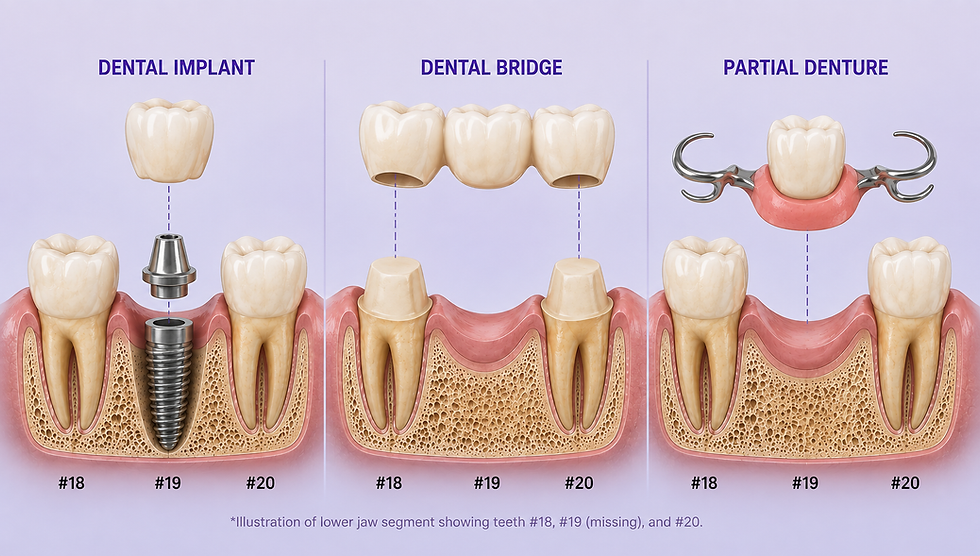
Understand the differences between a Dental Implant, Dental Bridge, and Removable Partial Denture.
DENTAL IMPLANT
DENTAL BRIDGE
PARTIAL DENTURE
Type
Fixed
Fixed
Removable
Replaces Tooth Root
Yes
No
No
Adjacent Teeth Altered
Usually No
Usually Yes
Usually No or Minimal
Bone Stimulation
Yes
No
No
Cleaning
Similar to a Natural Tooth
Clean Underneath Bridge
Remove for Cleaning
Surgery
Yes
Usually No
No
Key Benefit
Independent Tooth Replacement
Fixed Without Implant Surgery
Non-Surgical Removable Option
Requires Adequate Bone and Healing
Uses Neighboring Teeth for Support
Must Be Removed and Maintained
DENTAL IMPLANT
Use the existing website fonts, white background, and lavender/purple accent colors. Keep the design professional, modern, easy to scan, and consistent with the comparison section above.
Do not modify any existing sections above this section.
INTRODUCTION
A dental implant replaces a missing tooth from the root up. A titanium implant is placed into the jawbone and allowed to integrate with the surrounding bone. Once the implant is ready, an abutment and custom crown are attached to restore the missing tooth.
1. CONSULTATION & 3D EVALUATION
We evaluate the missing-tooth area, surrounding teeth, gums, available bone, your bite, and important anatomical structures.
A CBCT/3D scan may be used to evaluate the height, width, and quality of the available bone and to help plan the position and size of the implant.
If additional procedures such as bone grafting may be necessary, we will discuss them with you as part of your treatment plan.
2. PREPARING THE BONE & IMPLANT PLACEMENT
After the area is numbed, access to the bone is created as needed.
A sequence of specialized drills is used to gradually prepare the jawbone to the proper depth and diameter for the implant. The titanium implant is then carefully placed into the prepared site.
Depending on the condition of the bone, bone grafting may also be performed to provide additional support around the implant.
The implant may be covered during healing or may have a healing component placed above the gum, depending on the individual situation.
3. HEALING & BONE INTEGRATION
After placement, the implant needs time to integrate with the surrounding jawbone, a biological process called osseointegration.
Highlight this statement:
TYPICAL HEALING TIME: APPROXIMATELY 4–6 MONTHS
Some implants may be ready sooner, around 3 months. More complex situations—such as significant bone grafting, sinus augmentation, poor bone quality, or other healing considerations—may require 6–12 months before the final restoration.
The actual healing period depends on factors including implant stability, bone quality and quantity, implant location, grafting procedures, your bite, and how your body heals.
CAN I GET A TOOTH IMMEDIATELY?
Sometimes.
In selected cases, a temporary tooth may be attached to the implant on the day of placement or shortly afterward. This is commonly called immediate loading or immediate provisionalization.
ADVANTAGE:
The patient may have a temporary tooth during the healing period rather than waiting several months without one.
IMPORTANT LIMITATION:
The implant has not yet fully integrated with the bone. The temporary restoration must therefore be carefully designed to minimize excessive biting forces while the implant heals.
Immediate loading is not appropriate for every implant.
GOOD CANDIDATES GENERALLY HAVE:
Strong initial implant stability, adequate bone quality and quantity, a favorable bite, good oral hygiene, and an implant site suitable for immediate restoration.
When these conditions are not present, allowing the implant to heal before restoring it may provide a more predictable approach.
4. ABUTMENT & FINAL CROWN
Once the implant has healed sufficiently and is ready for restoration, an abutment is connected to the implant.
A digital scan or impression is then used to create a custom crown designed to restore the appearance and function of the missing tooth.
The final crown is attached to the abutment, completing the implant restoration.
5. LONG-TERM MAINTENANCE
A dental implant cannot develop a cavity, but the gum and bone surrounding the implant still require long-term care.
Regular brushing, cleaning around the implant restoration, professional dental cleanings, and periodic examinations and X-rays help us monitor the health of the implant and surrounding tissues.
FINAL NOTE
Every implant case is different. Your treatment sequence, healing time, need for bone grafting, and whether immediate loading is appropriate will depend on your individual condition.
End with:
EDUCATE. GUIDE. THE PATIENT DECIDES.
FORMAT INSTRUCTIONS:
Organize the information into clearly separated blocks or steps so it is easy for patients to read.
Make the 4–6 month typical healing time visually prominent.
Make the Immediate Loading section visually distinct, showing its advantage, limitation, and general candidate considerations.
Do not add claims, statistics, prices, testimonials, images, or treatment information that is not provided above.
Do not change or redesign any other section of the page. Modify only this blank section.
DENTAL BRIDGE
A dental bridge is a fixed restoration used to replace a missing tooth by using the neighboring teeth for support. Unlike a dental implant, a traditional bridge does not replace the missing tooth root and does not require implant surgery.
1. EVALUATION & TREATMENT PLANNING
We evaluate the missing-tooth area, the neighboring teeth, gums, bite, and supporting bone.
The teeth on either side of the missing tooth must be healthy and strong enough to support the bridge. Existing fillings, crowns, decay, fractures, periodontal condition, and the amount of remaining tooth structure are considered when determining whether a bridge is appropriate.
2. PREPARING THE SUPPORTING TEETH
The teeth on both sides of the missing tooth are numbed.
A portion of the enamel and tooth structure is carefully reduced using dental burs to create space for crowns that will support the bridge.
This preparation is generally not reversible because some natural tooth structure must be removed.
IMPORTANT: WHAT HAPPENS TO THE SUPPORTING TEETH?
Because a traditional bridge relies on the neighboring teeth for support, those teeth usually need to be prepared for crowns.
After preparation, some teeth may experience temporary sensitivity to temperature or biting. This often improves as the tooth settles.
In some cases, however, the nerve inside a prepared tooth may become persistently inflamed or damaged. If the symptoms do not resolve or the nerve becomes unhealthy, root canal treatment may be necessary.
This is an important consideration when comparing a bridge with a dental implant because a bridge requires treatment of the adjacent teeth.
However, if the neighboring teeth already have large fillings, existing crowns, significant wear, fractures, or other conditions that may require crowns or replacement crowns anyway, using those teeth to support a bridge may be a very reasonable option.
On the other hand, if the neighboring teeth are healthy and have little or no existing dental work, preserving them without preparation may be an important reason to consider a dental implant.
3. DIGITAL SCAN OR IMPRESSION & TEMPORARY BRIDGE
After the supporting teeth are prepared, a digital scan or impression is taken so the final bridge can be fabricated.
A temporary bridge may be placed to protect the prepared teeth and maintain appearance and function while the final restoration is being made.
4. FINAL BRIDGE PLACEMENT
The final bridge typically consists of crowns placed over the supporting teeth with an artificial replacement tooth, called a pontic, connected between them.
The bridge is evaluated for fit, bite, appearance, and contact with the surrounding teeth before it is permanently cemented.
Unlike a dental implant, a traditional bridge does not require several months of bone integration. Treatment can therefore often be completed much sooner when the supporting teeth and gums are ready.
5. LONG-TERM MAINTENANCE
Because the crowns and replacement tooth are connected, a bridge cannot be flossed between the units in the same way as separate natural teeth.
The area under the replacement tooth and around the supporting teeth must be cleaned regularly using appropriate flossing aids, interdental cleaners, or other recommended methods.
The supporting natural teeth can still develop decay, fractures, or gum disease, so good home care, professional cleanings, and periodic examinations and X-rays remain important.
EVERY CASE IS DIFFERENT
A dental bridge can provide a fixed tooth replacement without implant surgery, but it depends on the neighboring teeth for support.
Whether a bridge or dental implant makes more sense depends partly on the condition of those neighboring teeth, as well as your gums, bone, bite, health, treatment goals, and other individual factors.
We explain the options, advantages, and limitations so you can make an informed decision.
EDUCATE. GUIDE. THE PATIENT DECIDES.
REMOVABLE PARTIAL DENTURE
A removable partial denture is an appliance used to replace one or more missing teeth while some natural teeth remain.
Unlike a dental implant or a fixed bridge, a partial denture is removable. It may use the remaining natural teeth, the gums, and supporting tissues to help provide support and stability.
1. EVALUATION & TREATMENT PLANNING
We evaluate the missing-tooth area, remaining teeth, gums, supporting bone, and bite.
The health and position of the remaining teeth are important because they may help support and retain the partial denture.
We also evaluate how many teeth are missing and where they are located to determine the appropriate partial denture design.
2. DESIGNING THE PARTIAL DENTURE
A digital scan or impression is taken to create a model of your teeth and gums.
The partial denture is designed to replace the missing tooth or teeth while fitting around the remaining natural teeth.
Depending on the design, the partial denture may use metal or other types of clasps that engage selected natural teeth to help hold the appliance in position.
In some cases, small modifications to the supporting teeth may be recommended to improve the fit, support, or stability of the partial denture.
3. FABRICATION & FITTING
The partial denture is fabricated to fit your mouth and replace the missing tooth or teeth.
Once completed, it is placed in the mouth and evaluated for fit, stability, bite, comfort, and appearance.
Adjustments are commonly needed as you become accustomed to wearing the appliance.
4. GETTING USED TO A REMOVABLE PARTIAL DENTURE
A partial denture may initially feel different or bulky because it covers or contacts areas of the mouth that were previously uncovered.
Speaking and chewing may require an adjustment period.
Unlike a fixed bridge or dental implant, the partial denture can move slightly during function because it is removable and may receive support from both the natural teeth and the gums.
Most patients gradually become more comfortable with the appliance as they learn how to insert, remove, chew, and speak with it.
5. LONG-TERM MAINTENANCE
The partial denture should be removed regularly for cleaning, and the natural teeth and gums underneath and around the appliance must also be kept clean.
Special attention should be given to teeth contacted by clasps because plaque and food can accumulate around these areas.
Regular dental examinations are important so we can evaluate the supporting teeth, gums, bite, and fit of the partial denture.
Over time, the gums and bone can change. The partial denture may eventually require adjustment, relining, repair, or replacement.
IMPORTANT: ADVANTAGES & LIMITATIONS
A removable partial denture generally does not require implant surgery and can replace multiple missing teeth with one appliance.
It can also be a practical and more economical treatment option for patients who do not want surgery, are not candidates for implants, or prefer a removable solution.
However, because it is removable, it generally does not provide the same stability or feel as a fixed bridge or dental implant.
Clasps may be visible depending on their location and design, and the appliance must be removed and cleaned regularly.
The supporting teeth may also receive additional forces from the partial denture and its clasps, making good oral hygiene and regular dental care especially important.
EVERY CASE IS DIFFERENT
A removable partial denture may be an excellent option for some patients and a temporary or transitional solution for others.
The best choice depends on the number and location of missing teeth, the condition of the remaining teeth and gums, available bone, health, treatment goals, and budget.
We explain the options, advantages, and limitations so you can make an informed decision.
EDUCATE. GUIDE. THE PATIENT DECIDES.