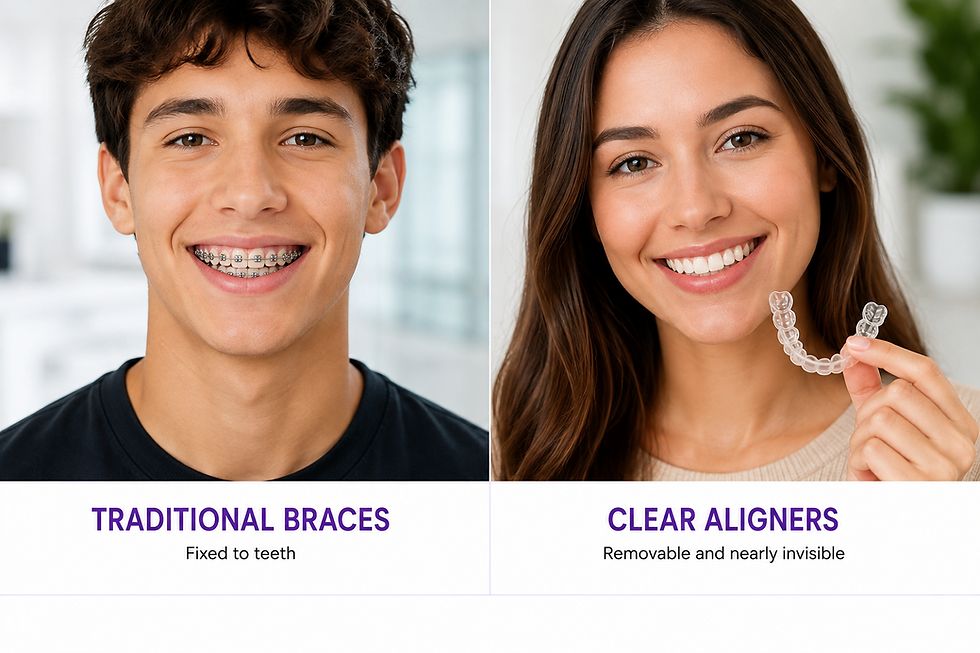
BRACES VS CLEAR ALIGNERS
TRADITIONAL BRACES
CLEAR ALIGNERS
TYPE
Fixed orthodontic appliance
Removable orthodontic appliance
HOW TEETH MOVE
Brackets and wires apply controlled forces to move the teeth
A series of custom aligners gradually move the teeth
PATIENT REMOVES IT
No
Yes
VISIBILITY
Brackets and wires are visible
Clear and more discreet
DAILY WEAR
Works continuously because the appliance is fixed
Typically worn about 20–22 hours per day
PATIENT COMPLIANCE
Less dependent on remembering to wear the appliance
Highly dependent on consistent daily wear
EATING
Some food restrictions may be needed
Remove aligners before eating
BRUSHING & FLOSSING
Requires careful cleaning around brackets and wires
Remove aligners for normal brushing and flossing
TREATMENT PROGRESS
Periodic orthodontic adjustments are performed
Change to the next aligner as directed and monitor treatment progress
TOOTH MOVEMENT
Can manage a wide range of orthodontic tooth movements
Suitability depends on the type and complexity of tooth movement required
KEY BENEFIT
Fixed treatment with less dependence on patient wear compliance
Discreet, removable, and easier access for brushing and flossing
KEY CONSIDERATION
Visible appliance and more difficult cleaning around brackets and wires
Must be worn consistently for treatment to progress as planned
ORTHODONTICS — TRADITIONAL BRACES
Orthodontics is the treatment of tooth position and bite relationships. Traditional braces use brackets attached to the teeth and orthodontic wires to apply controlled forces that gradually move the teeth into planned positions.
Because braces are fixed to the teeth, the patient does not remove them during treatment.
1. ORTHODONTIC EVALUATION & TREATMENT PLANNING
Treatment begins with an evaluation of the teeth, gums, bite, jaw relationship, facial profile, and available space for tooth movement.
Orthodontic records may include:
• Photographs
• Digital scans or impressions
• Dental X-rays
• Evaluation of the bite
• Evaluation of crowding or spacing
• Assessment of tooth and jaw relationships
These records help determine the orthodontic problem and develop an appropriate treatment plan.
2. PREPARING FOR ORTHODONTIC TREATMENT
Before braces are placed, the teeth and gums should be healthy enough for orthodontic treatment.
Existing cavities, significant gum inflammation, or other dental problems may need to be addressed first.
In some cases, creating adequate space for tooth movement may require additional procedures such as tooth removal, enamel reduction between selected teeth, or other treatment depending on the individual orthodontic condition.
Not every patient requires these procedures.
3. PLACING THE BRACES
Orthodontic brackets are bonded to the teeth.
An orthodontic wire is then placed through the brackets and secured in position.
The brackets and wires work together to apply controlled forces to the teeth.
Additional components such as elastics, springs, power chains, or other orthodontic appliances may sometimes be used depending on the movements required.
4. HOW DO BRACES MOVE THE TEETH?
Teeth are surrounded by bone and supporting tissues.
When controlled orthodontic forces are applied, these tissues gradually adapt and remodel, allowing the teeth to move through the bone.
Tooth movement occurs gradually.
Trying to move teeth too quickly or with excessive force is not the goal. Orthodontic treatment is planned to move the teeth in a controlled manner while monitoring the teeth and supporting tissues.
5. ORTHODONTIC ADJUSTMENTS
Patients return periodically so treatment progress can be evaluated.
During these visits, wires, elastics, or other components may be adjusted or changed to continue the planned tooth movement.
The frequency of visits depends on the treatment plan and stage of treatment.
Some soreness or pressure is common after braces are first placed or following certain adjustments.
This usually improves as the mouth adapts.
6. EATING WITH BRACES
Because the brackets and wires remain attached to the teeth, certain foods can damage the orthodontic appliances.
Patients may be advised to avoid or modify very hard, sticky, or chewy foods.
Food should also be cut into smaller pieces when appropriate rather than biting directly into foods that could place excessive force on the brackets.
Broken brackets or damaged wires can interrupt treatment and may require additional appointments.
7. CLEANING WITH BRACES
Good oral hygiene is especially important during orthodontic treatment.
Brackets and wires create additional areas where plaque and food can accumulate.
Patients must carefully brush around the brackets, along the gumline, and between the teeth.
Special flossing aids, interdental brushes, or other cleaning devices may be recommended.
Poor plaque control during orthodontic treatment can contribute to:
• Gum inflammation
• Cavities
• Permanent white-spot changes on the enamel
• Other oral health problems
Regular professional dental cleanings and examinations should continue during orthodontic treatment.
8. HOW LONG DOES TREATMENT TAKE?
Orthodontic treatment time varies considerably.
Treatment length depends on:
• Amount of tooth movement required
• Complexity of the bite
• Patient age and growth
• Biological response to treatment
• Condition of the teeth and supporting tissues
• Broken appliances or missed appointments
• Patient cooperation with elastics or other instructions
An estimated treatment time may be discussed after the orthodontic evaluation, but individual response to treatment can vary.
9. AFTER THE BRACES ARE REMOVED — RETAINERS
Orthodontic treatment does not end when the braces are removed.
Teeth have a natural tendency to shift after orthodontic movement.
Retainers are used to help maintain the new tooth positions.
Retainer wear is an important part of long-term orthodontic treatment.
Failure to wear retainers as instructed can allow the teeth to move or become crowded again.
IMPORTANT: ADVANTAGES & LIMITATIONS
Traditional braces can treat a wide range of orthodontic problems and do not depend on the patient remembering to wear the main appliance because the brackets and wires remain attached to the teeth.
However, braces are visible, require additional effort for cleaning, may require dietary modifications, and need periodic orthodontic appointments.
Some treatment also requires patient cooperation with elastics, oral hygiene, appointments, and other instructions.
EVERY CASE IS DIFFERENT
The type of braces, tooth movements required, treatment sequence, need for additional procedures, treatment time, and final result depend on the individual patient's teeth, bite, jaw relationship, supporting tissues, growth, and treatment goals.
We explain the treatment, alternatives, advantages, limitations, and expected responsibilities so you can make an informed decision.
EDUCATE. GUIDE. THE PATIENT DECIDES.
ORTHODONTICS — CLEAR ALIGNERS
Clear aligner therapy is an orthodontic treatment that uses a series of custom-made, removable aligners to gradually move the teeth into planned positions.
Unlike traditional braces, there are no brackets and wires permanently attached to the teeth. The aligners can be removed for eating, brushing, and flossing.
Our practice offers two clear aligner treatment systems:
• Invisalign®
• ProMonitoring™ Clear Aligners
Both systems use digitally planned clear aligners to move the teeth. The appropriate system depends on the patient's orthodontic needs, treatment complexity, lifestyle, monitoring needs, and treatment goals.
1. ORTHODONTIC EVALUATION & DIGITAL SCAN
Treatment begins with an evaluation of the teeth, gums, bite, jaw relationship, facial profile, and available space for tooth movement.
Orthodontic records may include:
• Digital scan of the teeth
• Photographs
• Dental X-rays
• Evaluation of crowding or spacing
• Evaluation of the bite
• Assessment of tooth and jaw relationships
These records help determine whether clear aligner therapy is appropriate and allow us to develop an individualized treatment plan.
2. DIGITAL TREATMENT PLANNING
The planned tooth movements are designed digitally before the aligners are manufactured.
This allows us to evaluate how the teeth are expected to move throughout treatment and make adjustments to the treatment plan when necessary.
Once the treatment plan is approved, a series of custom aligners is manufactured.
Each aligner represents another step toward the planned tooth positions.
3. WEARING YOUR ALIGNERS
Each aligner is designed to gradually move the teeth toward the planned position.
Clear aligners generally need to be worn approximately 20–22 hours per day.
They should normally be removed for:
• Eating
• Drinking beverages other than water
• Brushing
• Flossing
The aligners are changed according to the prescribed treatment schedule.
IMPORTANT: PATIENT COMPLIANCE MATTERS
Clear aligner treatment depends heavily on patient cooperation.
Because the aligners are removable, they only work when they are being worn.
If aligners are not worn consistently, the teeth may not move as planned, the next aligner may not fit properly, and treatment may take longer or require additional correction.
For patients who feel they may have difficulty wearing aligners consistently, traditional braces may sometimes be a more appropriate treatment option.
4. ATTACHMENTS & OTHER PROCEDURES
Some tooth movements require small tooth-colored attachments to be bonded to selected teeth.
These attachments help the aligners apply controlled forces in specific directions.
In some cases, additional orthodontic procedures or components may be recommended, including:
• Interproximal reduction (IPR) to create small amounts of space between selected teeth
• Elastics
• Additional attachments
• Other orthodontic techniques
Not every patient requires these procedures.
5. INVISALIGN®
Invisalign® is a well-established clear aligner system that uses digital treatment planning and a series of custom-made aligners to gradually move the teeth.
Patients can also use the My Invisalign™ app to help manage their treatment.
Depending on the treatment setup and services being used, patient tools may include:
• Aligner wear tracking
• Aligner-change reminders
• Progress photographs
• Smile progress tracking
• Appointment reminders
When remote monitoring features are incorporated into the treatment workflow, patients may also be able to submit progress information between office visits.
LEARN MORE ABOUT INVISALIGN®:
https://www.invisalign.com/
6. PROMONITORING™ CLEAR ALIGNERS
ProMonitoring™ combines clear aligner treatment with a remote digital monitoring system.
Patients use the ProMonitoring app and smartphone-based scanning technology to regularly capture images or scans of their teeth from home.
This allows treatment progress to be followed between office visits.
The monitoring system can assist with evaluating:
• Aligner fit and tracking
• Tooth movement
• Treatment progress
• Oral hygiene observations
• Patient scan compliance
Patients receive instructions and reminders regarding when to submit their scans.
The submitted information allows treatment progress to be reviewed remotely.
Based on treatment progress and clinical review, the patient may receive instructions regarding whether to continue wearing the current aligner or advance to the next aligner.
This provides an additional level of treatment monitoring between scheduled office visits and may reduce the need for some routine in-office progress checks.
LEARN MORE ABOUT PROMONITORING™:
https://www.promonitoring.ai/
7. INVISALIGN® VS PROMONITORING™
Both systems provide professionally supervised clear aligner treatment, but the treatment platforms and monitoring experience are different.
INVISALIGN®
Invisalign is an established clear aligner system with comprehensive digital treatment planning, Invisalign-manufactured aligners, and patient tools available through the My Invisalign app.
PROMONITORING™
ProMonitoring combines clear aligner treatment with smartphone-based remote monitoring designed to help evaluate aligner tracking and treatment progress between office visits.
PRICING
We believe patients should be able to compare both the treatment features and the cost.
For comparable treatment tiers offered by our practice, ProMonitoring is currently priced approximately $600 less than the corresponding Invisalign treatment tier.
The lower treatment fee does not mean that professional orthodontic supervision is eliminated. ProMonitoring incorporates remote digital monitoring that allows treatment progress and aligner tracking to be followed between scheduled office visits.
When both systems are appropriate for your case, we will show you the available treatment options and fees for both so you can compare before deciding.
Price alone should not determine the treatment system. The type of tooth movement required, bite, treatment complexity, patient cooperation, monitoring needs, and capabilities of each system must also be considered.
8. MONITORING YOUR TREATMENT
Clear aligner treatment must be monitored to determine whether the teeth are following the planned movements.
Depending on the treatment system, monitoring may involve:
• In-office progress examinations
• Digital photographs or scans
• Remote monitoring
• Evaluation of aligner fit
• Evaluation of the bite and tooth movement
Technology can help us monitor treatment, but it does not replace professional clinical judgment.
An in-office examination may still be necessary whenever there is a concern or when direct clinical evaluation is appropriate.
9. REFINEMENTS & ADDITIONAL ALIGNERS
Teeth do not always move exactly as predicted.
During treatment, progress is evaluated to determine whether the teeth are following the planned movements.
If additional tooth movement is necessary, another digital scan may be taken and additional aligners, often called refinements, may be prescribed.
Refinements are a normal part of clear aligner treatment in some cases and do not necessarily indicate that treatment has failed.
10. CLEANING & ORAL HYGIENE
One advantage of removable aligners is that they can be taken out for normal brushing and flossing.
However, both the teeth and aligners must be kept clean.
Placing aligners over teeth that have not been properly cleaned can trap food, plaque, and sugars against the teeth.
Patients should maintain good daily oral hygiene and continue regular professional dental examinations and cleanings throughout orthodontic treatment.
11. AFTER ALIGNER TREATMENT — RETAINERS
Completing the final aligner does not mean orthodontic treatment is finished.
Teeth naturally have a tendency to shift after orthodontic movement.
Retainers are used to help maintain the corrected tooth positions.
Long-term retainer wear is an important part of maintaining the orthodontic result.
Failure to wear retainers as instructed can allow the teeth to shift or become crowded again.
IMPORTANT: ADVANTAGES & LIMITATIONS
Clear aligners are removable, discreet, and provide easier access for brushing and flossing than fixed braces.
They can provide an effective orthodontic treatment option for many patients.
However, successful clear aligner treatment depends heavily on wearing the aligners consistently and following the prescribed treatment and monitoring schedule.
Clear aligners may not be appropriate for every orthodontic problem.
Depending on the type and complexity of tooth movement required, traditional braces, additional orthodontic techniques, or referral for more complex orthodontic treatment may sometimes be recommended.
EVERY CASE IS DIFFERENT
The appropriate aligner system, treatment tier, number of aligners, attachments, need for IPR or elastics, treatment time, monitoring schedule, refinements, and final result depend on the patient's teeth, bite, supporting tissues, treatment complexity, cooperation, and biological response.
When more than one treatment option is appropriate, we explain the differences, advantages, limitations, responsibilities, and fees so you can make an informed decision.
EDUCATE. GUIDE. THE PATIENT DECIDES.